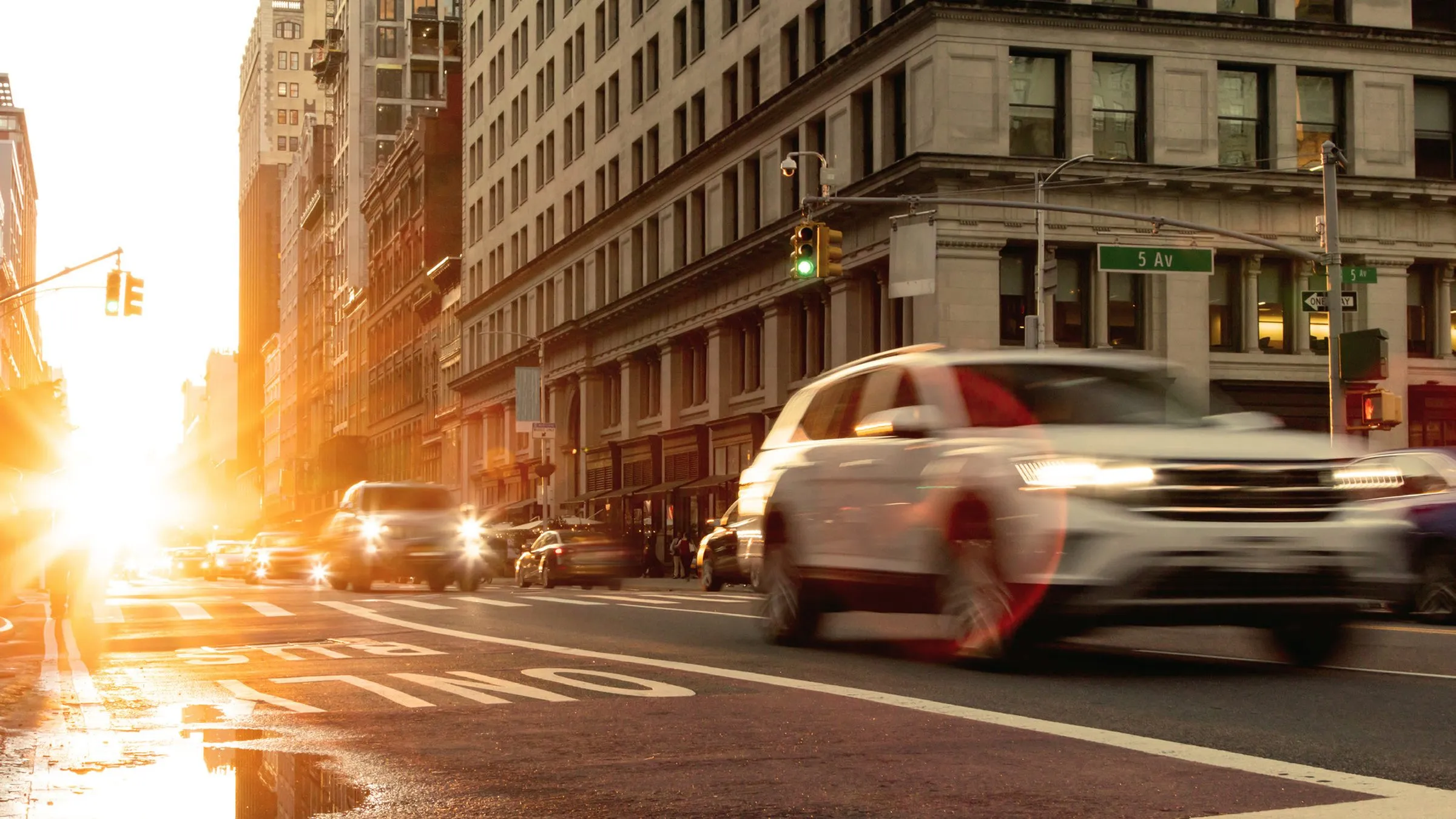
There is a corner in your city where the same near accident has happened a hundred times. A driver drifts. Someone brakes a beat late. A pedestrian steps off the curb half a second early. Almost every time, nothing happens. Then one day the timing is slightly worse, and the near miss becomes the collision that makes the local news.
All hundred of those warnings disappeared the moment they happened. Nobody wrote them down. Nobody could have. The corner keeps its secret until it doesn't.
Now picture a machine driving through that corner for the first time.
For most of computing history, software lived in a world we built for it. Email, documents, spreadsheets, web pages, maps, and databases. The information a machine needed was already there, already structured, already waiting. AI got very good at that world, and it got good because we had already written that world down. The internet became a collective memory.
But the next chapter of AI is not about answering questions. It is about making decisions.
AI is leaving the screen. It will drive vehicles, route freight, inspect bridges, dispatch first responders, move robots through warehouses, and help cities operate. Its job will not be to produce information. Its job will be to understand the world well enough to act inside it.
Here is the problem. The real world never got an internet.
Billions of things happen every day that nobody writes down. A lane closes. A signal timing changes. A storm pushes debris across two lanes. A driver brakes hard for a reason no one records. A near miss happens, like the hundred at that corner, and then it is gone. Almost none of it leaves behind anything another person, or another machine, can learn from.
We manage that with experience and intuition. We know the intersection that backs up when school lets out and the ramp that turns treacherous in heavy rain. We carry that context because we lived it.
Machines don't.
AI coming off the screen will only ever be as good as the reality it understands.
Which is why I think one of the most important things we need to build for this next era isn't another model. It's a way for machines to understand the real world as it changes.
What the road taught me
I came to this through transportation.
Before Nexar, I spent nearly six years at Lyft, and I learned a tremendous amount from John Zimmer. Back in 2016 John wrote about a future where autonomous, shared vehicles would change how we move and reshape the cities we move through and how they are built. I still believe most of that. What I did not appreciate then is how much has to happen underneath it for any of it to work.
A vehicle moving through the world is doing something categorically different from software running on a screen. It cannot rely on what was true when it was trained. It has to know what is true now.
Is that shape in the lane debris or a shadow? Did the work zone shift since yesterday? Is this intersection behaving the way the map claims it does? Is this driver heading into a situation that has already caused three collisions on this stretch of road?
The physical world does not wait for a software update.
Roads are messy and unpredictable. They are shared by people and machines, governed by rules that are followed unevenly, and reshaped by conditions that turn over minute by minute. They are also full of signals we have historically thrown away. A collision usually creates a record. A near miss usually doesn't. Neither does the hard brake two seconds before it, nor the glance down at exactly the wrong moment, nor the same dangerous pattern repeating a hundred times at one corner before anyone notices there is a pattern at all.
Nexar and Nauto came at this from opposite ends. One was built to understand what was happening on the road. The other was built to catch risk in and around commercial vehicles early enough to change how the day ends. Different starting points, but both exposed us to something unusually difficult to create: real-world experience and observation at scale.
Not footage sitting in an archive. Experience you can turn into understanding. What happened? What almost happened? What changed? What usually happens next?
And there was one thing I didn't fully appreciate at first:
You cannot go back and collect yesterday.
If nobody captured the near miss at that corner last Tuesday, you cannot decide six months from now that you wish you had. If the road changed this morning, a photo of it from last spring will not tell a machine what it needs to know. The physical world produces new information every second and then throws most of it away.
Context has an expiration date
Almost all of the progress in AI came from giving machines more of what already exists. More text, more images, more video, more code, more examples of how people solved things before. The results are hard to believe if you remember where we were five years ago.
But learning from the world and operating in it are two different jobs.
A model can learn from a photograph of a flooded road. A truck approaching that road needs to know whether it is flooded right now. A system can study a decade of traffic patterns. A city managing an emergency needs to know what changed in the last hour.
When software recommends the wrong movie, very little happens. When a machine operating in the physical world makes the wrong decision, the consequences can be very different.
This is not a knock on the models. The models are extraordinary. It is a statement about context, and context expires. A map is useful until the road changes. A risk score is useful until the conditions that produced it change. A model trained on yesterday's world can be brilliant and still be reasoning about a world that no longer exists.
You can see the need forming in transportation, robotics, logistics, insurance, public safety, infrastructure, and in industries none of us are thinking about yet. The applications could not be more different. The question underneath them is nearly identical.
What is true here, right now?
That is harder to answer than it sounds. One observation is rarely enough. It usually takes knowing what happened before, recognizing the pattern across many similar situations, and telling the difference between something unusual and something that actually matters. Then you have to do it again tomorrow, because tomorrow is different. And again, because the next hour is different.
The internet gave machines access to what humanity knows. The next challenge is giving them access to what the world knows now.
Nobody sees enough of the world alone
No single company solves this.
The world is too big and moves too fast. No autonomous vehicle will encounter every situation it needs to understand. No robot will enter every environment it might enter. No city, fleet, insurer, or technology company sees enough of the world on its own to anticipate what can happen in it. I also do not think we should ask them to.
The internet became valuable because knowledge stopped being trapped inside the organizations that produced it. It could be connected, searched, compared, and built on. Whole industries exist because there were common systems underneath them.
The same thing has to happen as intelligence moves into the physical world. Not one giant model that runs everything. Not a perfect simulation of reality. Not one company decides how every machine should behave. Something more basic: a way for a system operating in the world to benefit from experience beyond its own.
A dangerous pattern seen by thousands of vehicles helping the vehicle that is meeting that road for the first time.
A change on a street reaching the systems navigating it without waiting for someone to update a map by hand.
A near miss that taught one fleet something real contributing to a broader picture of risk before the same setup becomes a collision three states away.
None of this means every observation should be shared or that every system should see everything. Privacy, security, ownership, and responsible use matter enormously, and they matter more when the data comes from the physical world.
There is one more requirement that gets underestimated: independence. Companies need to benefit from a wider view of the world without handing an edge to a competitor. The common systems underneath an industry only work when the companies building on top of them can trust that the infrastructure is not trying to become them.
People have always understood this instinctively. Very little of what any of us knows came from what we personally lived through. We inherit it from other people's observations, mistakes, and judgment.
We inherit experience. Machines mostly don't.
They don't need to know everything. They need to know enough about what is happening around them to make a better decision. That, more than raw capability, is what will decide how well AI makes the jump from the digital world into ours.
What comes next
This is the idea behind Empiric Earth.
Empiric Earth brings together more than a decade of making sense of what happens on real roads. That is over 10 billion miles of driving today, with hundreds of millions of new miles added every month.
The scale matters. What it makes possible matters more.
We are not trying to build every vehicle, robot, application, or system that will operate in the physical world. The companies building those things understand their customers and their products far better than we ever will. What we can do is help them answer the question that gets more important the more capable their systems become.
What is happening in the world that my system needs to understand before it acts?
That is the work. Not replacing the intelligence inside a vehicle or a robot, but giving it better context. Not deciding what an application should do, but helping it understand the environment it is deciding in.
Transportation is where we learned how to do this, and roads are one of the richest, most demanding environments in the physical world. There is still an enormous amount of work ahead of us there. But the need does not stop at the road.
As more intelligence moves into the physical world, every system runs into the same problem. The world changes faster than its understanding of it.